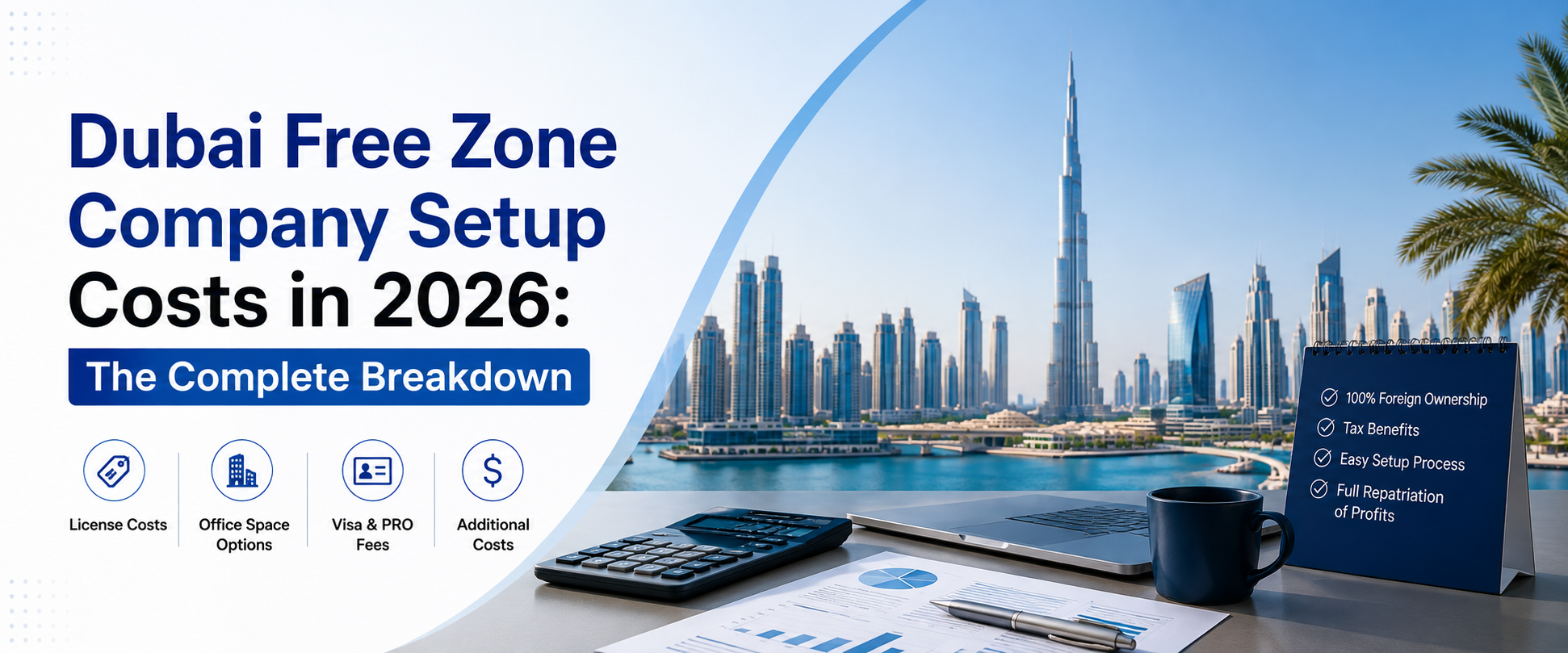
Everything it really costs to complete a business setup in Dubai Free Zone – licence fees, visas, office space, and the hidden extras most guides leave out.
Quick Answer
If you’re comparing quotes for business setup in Dubai free zone, here’s the number that matters: a bare licence with no visa can start as low as AED 6,000–13,000, but a realistic first-year total – licence, establishment card, and one visa – usually falls between AED 20,000 and AED 35,000, depending on which free zone you choose. Premium zones like DMCC push the all-in first-year figure to AED 35,000–45,000. The advertised “starting from” price is almost never what a founder actually pays, and understanding why is the difference between budgeting properly and being caught off guard at signing.
1. Why Dubai Free Zone Business Setup Costs Vary So Much
Ask five consultants “how much does it cost to setup a company in Dubai free zone?” and you’ll get five different answers – and all of them can be correct, because the final number depends on variables that change from one applicant to the next:
- Which free zone you register with – a Meydan or RAKEZ package is priced very differently from a DMCC package
- How many visas your licence needs to sponsor
- Your business activity – some activities require additional approvals, external NOCs, or a higher-tier licence
- Office requirement – a virtual address, a flexi-desk, or a private office all carry very different price tags
- Number of shareholders and business activities bundled into the package
This guide is built entirely on current 2026 figures sourced from the free zone authorities and verified market data, so you can budget an accurate Dubai freezone business setup cost instead of anchoring on a marketing headline. Whether you’re exploring business setup in UAE for the first time or comparing free zone options against a mainland licence, the breakdown below gives you the real numbers.
2. What’s Actually Included in “Free Zone Setup Cost”
The figure you see in ads and comparison sites – “licences from AED 12,900” – is almost always just the trade licence fee. It typically excludes:
- The establishment (immigration) card, required before you can sponsor any visa
- Visa processing, medical testing, and Emirates ID
- Office space beyond the most basic virtual address
- Optional business activity approvals
In practice, a package advertised at AED 12,900 commonly lands at AED 20,000–31,500 in true first-year cost once a single visa and the mandatory cards are added. The components below make up the real total for any company setup in UAE through a free zone structure.
3. Core Cost Components of Dubai Free Zone Business Setup
Registration / Trade Licence Fee
This is the base fee that gives you legal permission to trade. Pricing varies enormously by authority:
| Free Zone | Starting Licence Fee (0–1 Visa) |
| RAKEZ | AED 6,010 (no-visa, multi-activity) |
| Meydan | AED 12,500 (0-visa, virtual office, 3 activities) |
| IFZA | AED 12,900 (0-visa) / AED 14,900 (1 visa) |
| DMCC | AED 20,265 (1 year, trading licence) |
Figures are indicative 2026 starting prices and shift frequently – always confirm the current rate card directly with the authority or your consultant.
Establishment / Immigration Card
Before your company can sponsor a single visa, it needs this card. Budget AED 1,500–2,500 per year, plus a separate Immigration Card (ICP) fee of roughly AED 1,200–1,500 at some zones – two line items that rarely appear in a headline “starting from” price.
Office Space: Flexi-Desk vs. Private Office
- Virtual/flexi-desk – included in most base packages (Meydan, IFZA, RAKEZ)
- Shared or dedicated desk upgrade – roughly AED 3,500/month at Meydan
- Private office – AED 15,000–30,000+/year depending on zone and size
- DMCC – a physical office is mandatory, adding AED 16,000–19,000/year on top of the licence
Visa Costs
A single UAE residence visa (investor or employee) typically costs AED 3,400–6,500 all-in, covering:
- Entry permit: AED 350–750
- Medical fitness test: AED 300–700
- Emirates ID: AED 370–500 (for a standard 2-year visa)
- Visa stamping and basic health insurance: remainder of the total
Per-zone examples: IFZA visas run roughly AED 3,800–4,800 each; a business setup in Meydan free zone prices visas at about AED 3,500 each; RAKEZ adds AED 4,000 per additional visa.
Optional / Hidden Costs
- Extra business activities beyond your package limit: AED 1,000–2,500 each
- Mandatory annual audit (DMCC and some other zones): AED 5,000–15,000/year
- Bank account minimum balance: not a fee, but a cash commitment your bank will require
- PRO services and amendments – activity changes, trade name changes, share transfers
4. Cost Comparison Across Popular Free Zones
| Free Zone | Starting Price | Realistic Year-1 Total (1 Visa) | Best For |
| RAKEZ | AED 6,010–12,010 | ~AED 16,000–20,000 | Budget-conscious trading/industrial setups |
| Meydan | AED 12,500 | ~AED 20,000–22,000 | E-commerce, freelancers, solo founders |
| IFZA | AED 12,900 | ~AED 20,700–22,200 | SMEs, consultants, wide activity list |
| DMCC | AED 20,265 | ~AED 35,000–45,000 | Trading, commodities, premium credibility |
These are indicative, cross-checked estimates as of mid-2026. Free zone pricing changes often through promotions and fee revisions – treat this table as a planning guide, not a fixed quote.
5. Free Zone vs. Mainland: A Quick Cost Comparison
Mainland company formation generally carries higher setup and compliance costs than a free zone licence, partly because mainland visa processing runs through MOHRE with its own fee structure, while free zone authorities handle immigration internally. As a rough planning figure, budget around AED 5,000 per mainland employment visa versus AED 2,000–4,500 for the equivalent free zone visa.
Mainland is generally worth the extra cost when you need to trade freely across the UAE without a local distributor, or when your target clients specifically require a mainland-licensed vendor. For most founders exploring business setup in Dubai free zone for the first time – consultants, service providers, e-commerce operators, and holding structures – the free zone route remains the faster and more cost-efficient path to market.
6. Free Zone vs. Offshore: What’s the Difference?
Founders researching offshore company formation in Dubai often confuse it with a free zone setup – the two serve different purposes entirely:
- A free zone company can hold a physical presence in the UAE, sponsor employee visas, and (depending on activity) trade with mainland and international clients under its trade licence.
- An offshore company setup in Dubai (e.g. through JAFZA Offshore or RAK ICC) is designed for holding assets, international trade, or corporate structuring – it cannot sponsor UAE residence visas or lease office space, and it cannot conduct business inside the UAE itself.
If your goal is to physically operate, hire staff, and hold a UAE residence visa, a free zone licence – not an offshore entity – is the correct structure. Offshore formation suits investors and holding companies with no operational presence requirement in the UAE.
7. Ongoing / Annual Costs After Setup
Setup is only year one. Budget for these recurring costs when planning your company setup in Dubai:
- Licence renewal – often close to the original licence fee (IFZA renewal with 1 visa: ~AED 17,100; Meydan renewal: AED 12,500 flat regardless of licence type)
- Visa renewals – similar to initial issuance costs, every 2 years
- Compliance – VAT registration becomes mandatory once turnover exceeds AED 375,000; Corporate Tax registration is mandatory for every free zone company, even where the qualifying rate is 0%
- Office lease renewal – if you’ve upgraded beyond a virtual address
8. What Pushes Your Cost Up or Down
- Number of visas – the single biggest cost driver after the licence itself
- Number of business activities – packages typically cap you at 1–3 activities before extra fees apply
- Physical office requirement – mandatory at DMCC, optional (but recommended for banking relationships) elsewhere
- Free zone authority chosen – the gap between RAKEZ and DMCC can exceed AED 25,000 in year one for a broadly equivalent setup
9. Sample Year-One Budget: Solo Founder, Service Licence, 1 Visa
| Item | Estimated Cost (AED) |
| Licence (service/professional) | 12,900 |
| Establishment card | 2,000 |
| Visa (entry permit, medical, Emirates ID, stamping) | 4,300 |
| Basic health insurance | included above |
| Total Year 1 | ~19,200–21,000 |
This is a representative IFZA- or Meydan-style solo-founder scenario. Add AED 1,000–2,500 per extra activity, or AED 3,500–4,500 per additional visa, if your plans go beyond this baseline.
10. Why Work With a Business Setup Consultant
Free zone pricing looks simple on a landing page and becomes considerably more complex the moment your activity list, visa count, or banking needs don’t match the standard package. This is where business setup consultants in Dubai earn their fee – not by making the licence cheaper, but by preventing the expensive mistakes that inflate a “AED 12,900” quote into a AED 40,000 surprise:
- Matching your actual invoicing plan to an activity list before you commit, so you’re not paying AED 1,000–2,500 per activity to expand later
- Choosing the free zone whose banking relationships fit your industry, since not every zone opens doors equally at every bank
- Structuring visa allocation correctly the first time, avoiding amendment fees
- Advising honestly on when a corporate service provider in Dubai should recommend mainland or offshore instead of free zone, based on your actual business model
As a corporate service provider in Dubai, VIRTUE Corporate Services works across IFZA, Meydan, DMCC, and RAKEZ, handling licensing, visa processing, and bank account introductions end-to-end – the kind of corporate business services Dubai founders need when they want one accurate quote instead of five conflicting ones. If you’re comparing corporate services UAE-wide, the right partner should be pricing your actual activity and visa needs, not a generic package.
11. How to Get an Accurate Quote
Every figure in this guide is indicative – free zone pricing shifts through the year via promotions and fee revisions. For a number you can actually budget against:
- Use the free zone authority’s own cost calculator where available
- Get a written quote itemising licence, cards, visas, and office – not just the headline price
- Cross-check against Invest in Dubai’s official company set-up comparison for the current government framework, and the Dubai Unified Licence guide if you’re weighing free zone against mainland
- Treat any third-party “from AED X” figure as a floor, not a total
12. The Bottom Line
Budget for the full package, not the licence fee alone. A Dubai free zone business setup genuinely can start under AED 15,000 – but almost nobody pays only that. Plan around the realistic Year 1 total (licence + card + at least one visa), and get a like-for-like written quote before you commit to a zone.
Frequently Asked Questions
1. How much does it cost to set up a company in a Dubai free zone in 2026?
Starting licence fees range from around AED 6,010 (RAKEZ, no visa) to AED 20,265 (DMCC). A realistic first-year total including one visa typically falls between AED 20,000 and AED 35,000, depending on the free zone, activity, and office requirement.
2. What is the cheapest free zone for business setup in Dubai?
Among Dubai-based zones, Meydan and IFZA offer the most competitive entry pricing, both starting around AED 12,500–12,900 for a zero-visa package. RAKEZ, based in Ras Al Khaimah, is typically cheaper still if a Dubai address isn’t a requirement for your business.
3. Does the advertised licence fee include visas and office space?
No. The headline licence fee almost always excludes the establishment card, visa processing, medical testing, Emirates ID, and any office upgrade beyond a basic virtual address. These typically add AED 7,000–15,000 to the advertised price for a single-visa setup.
4. Is a free zone company allowed to do business anywhere in the UAE?
A free zone company is licensed to operate within its free zone and internationally. Trading directly with mainland UAE clients generally requires either a mainland distributor, a dual-licence structure, or specific activity permissions – this depends on your business activity and should be confirmed before you choose your licence type.
5. What’s the difference between a free zone and an offshore company in Dubai?
A free zone company can lease office space, sponsor UAE residence visas, and operate a physical presence. An offshore company (such as JAFZA Offshore) is for holding assets or structuring international trade – it cannot sponsor visas or hold a UAE operating address.
6. How many visas can I get with a Dubai free zone licence?
Most zones allow between zero and six visas per licence, tied to your office type and package tier. Meydan and IFZA both cap standard packages at six visas; higher allocations are usually possible with a private office.
7. Do free zone companies pay Corporate Tax in the UAE?
Free zone companies must register for Corporate Tax regardless of their qualifying status. Businesses meeting the Qualifying Free Zone Person conditions can benefit from a 0% rate on qualifying income, but registration itself is mandatory for every entity.
8. How long does it take to complete a business setup in the Dubai free zone?
Most zones issue initial approval within 24–48 hours and a trade licence within 3–5 working days of document submission. Full setup including visa stamping and Emirates ID typically takes 2–4 weeks.
9. Do I need to visit the UAE to set up a free zone company?
Not necessarily. You can complete company registration and obtain a trade licence remotely. If you want a residence visa attached to the licence, you’ll need to enter the UAE at least once to complete the medical test and Emirates ID biometrics.
10. Can I open a corporate bank account after setting up a free zone company?
Yes. Once your licence is issued, you can apply for a corporate account with any UAE bank. Banking approval depends on your activity, shareholder nationality, and the free zone’s existing relationships with local banks – this is one of the areas where an experienced consultant adds real value.
11. What ongoing costs should I budget for after the first year?
Licence renewal (often close to the original fee), visa renewals every two years, VAT registration once turnover exceeds AED 375,000, and Corporate Tax compliance. DMCC entities also carry an annual audit requirement.
12. Should I use a business setup consultant or apply directly?
Applying directly is possible, but a consultant who works as a genuine corporate service provider in Dubai – rather than a reseller for a single free zone – can match your activity list and visa needs to the right authority the first time, avoiding costly amendments later.
Planning your business setup in UAE and want an itemised quote across IFZA, Meydan, DMCC, and RAKEZ? Get in touch with VIRTUE Corporate Services for a transparent, activity-matched cost breakdown before you commit to a free zone.