This guide is written and maintained by our business setup advisory team, who handle mainland and free zone company formation, licensing, and visa applications for foreign founders in Dubai on an ongoing basis. Every step below reflects current UAE Commercial Companies Law, Department of Economy and Tourism (DET) licensing rules, and Federal Tax Authority guidance. Because free zone fee schedules, Golden Visa thresholds, and Emiratisation quotas are revised periodically, we recommend confirming exact figures with the relevant authority or with our team before filing – this article is educational and does not constitute legal, tax, or immigration advice.
Dubai has spent the last few years pulling down almost every barrier that used to stop outsiders from owning a company here outright. Sponsor requirements have been rolled back, licensing has gone largely digital, and the emirate now positions itself as one of the fastest places in the world to go from idea to trading company. That doesn’t mean the process is automatic – it just means the founders who move fastest are the ones who understand the rules before they start filling out forms.
This guide walks you through exactly what to expect, whether you’re weighing business setup in Dubai free zone options or a mainland license, and where to bring in a corporate service provider in Dubai if you’d rather not manage the paperwork yourself.
Can Foreigners Own 100% of a Business in Dubai?
Yes, in almost every case. Free zones have always allowed full foreign ownership, and reforms to the UAE’s Commercial Companies Law extended 100% ownership to mainland companies across more than a thousand commercial, professional, and industrial activities. The old requirement for a local Emirati sponsor holding 51% has been eliminated for most sectors – it only survives in a small number of strategic industries, such as oil and gas, where local participation is still mandatory.
In practice, this means the ownership question no longer decides your jurisdiction for you. Instead, your choice between a free zone and the mainland should come down to where your customers are, how you plan to operate, and how much regulatory flexibility you need.
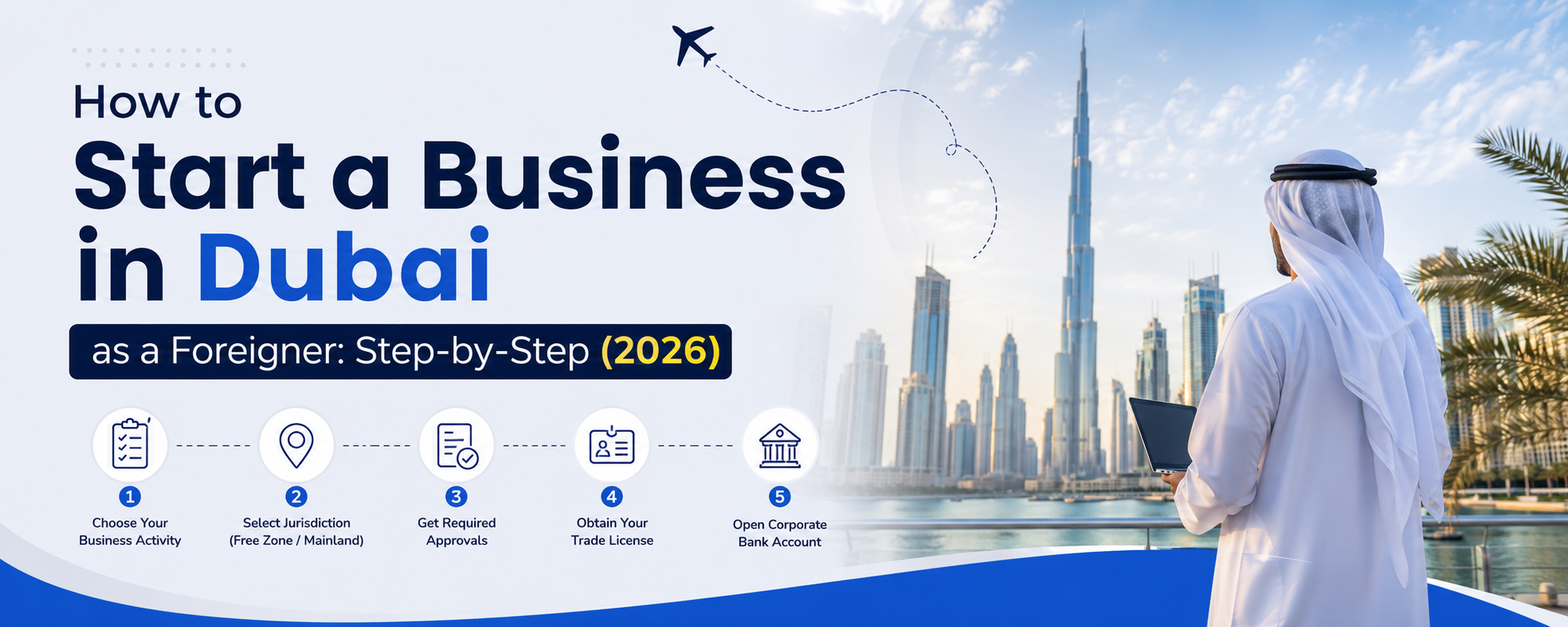
Step 1: Choose Your Business Activity
Every UAE license is tied to one or more specific “business activities” chosen from an official list maintained by the relevant authority. This single decision shapes almost everything downstream – which jurisdictions will accept you, what approvals you’ll need, and what your license will ultimately cost.
The DET maintains a list of over 2,100 licensable activities spanning industrial, commercial, professional, and tourism categories, and each one determines which license type you’ll be issued: Commercial (trading and buying/selling goods), Industrial (manufacturing), Professional (consultancy, IT, legal, and other services), Tourism, Agricultural, or Crafts.
Get specific early. A generic “general trading” activity looks flexible on paper but often triggers extra approvals and higher fees. A tightly defined activity – say, software development or management consultancy, which falls under a Professional license – usually moves through licensing faster and cleaner. If you’re not sure how your business fits the official categories, this is exactly the kind of question worth putting to a setup consultant before you file anything.
Step 2: Choose a Jurisdiction – Free Zone, Mainland, or Offshore
This is the decision that shapes your company’s entire operating model, so it deserves more than a cost comparison.
Free zone. A dubai free zone business setup is the default choice for consultancies, e-commerce brands, tech and SaaS companies, and anyone serving clients mostly outside the UAE. Free zones offer 100% ownership, streamlined online registration, and – for qualifying activities – 0% corporate tax on qualifying income. The trade-off is that a free zone company generally can’t trade directly with the UAE mainland market without going through a distributor or setting up a separate mainland presence. Dubai has over 30 free zones, each built around specific industries, so setup company in Dubai free zone decisions often hinge on picking the zone that matches your sector rather than just the cheapest package.
Mainland. A mainland license, issued through Dubai’s Department of Economy and Tourism, lets you trade anywhere in the UAE, bid on government contracts, and open retail locations without geographic restriction. It suits businesses that need face-to-face dealings with local customers or government bodies. Mainland companies must lease a physical office of at least 200 square feet – virtual offices aren’t accepted – and are subject to 5% VAT and the standard 9% corporate tax on profits above AED 375,000. Companies with 50 or more employees must also ensure at least 2% of their workforce is Emirati nationals in skilled roles, and companies with 25–49 employees must hire at least one Emirati.
Offshore. Offshore companies (often registered through a free zone) are used mainly for holding assets, international trading, or tax structuring rather than operating a physical business inside the UAE. They can’t trade with the local UAE market, typically can’t lease local office space or sponsor UAE residency visas, and can face extra scrutiny when opening a local corporate bank account – so they’re a narrower tool suited to specific structuring needs rather than a general-purpose setup route.
Many founders default to whichever option looks cheapest on a landing page, then find themselves restructuring within a year or two once their business outgrows the original setup. Mapping your five-year plan against jurisdiction rules before you commit will save you that headache.
Step 3: Reserve a Trade Name
Once your activity and jurisdiction are settled, you’ll reserve a trade name with the relevant authority – the DET for mainland companies, or your chosen free zone authority. UAE naming rules are fairly strict: names can’t reference religious or political groups, can’t use language implying a scope beyond your license, and generally shouldn’t include abbreviated personal names unless you’re forming a civil company. Reservation is usually quick, but it’s worth having two or three backup names ready in case your first choice is taken or rejected on compliance grounds.
Step 4: Apply for Your Trade License
This is where your business becomes legally real. You’ll submit your application along with supporting documents – typically passport copies of all shareholders and the appointed manager, signature samples, a completed application form, and (for branches or subsidiaries) articles of incorporation. Free zones often run this almost entirely online, while mainland applications may involve additional approvals from other government departments depending on your activity.
Timelines vary by jurisdiction: a straightforward free zone license can be issued in a matter of days, while mainland licenses and regulated activities typically take a few weeks once every approval is accounted for. Costs also range widely – budget-friendly free zone packages start in the low thousands of AED for a license with no dedicated office, while premium free zones and mainland LLCs can run well into five figures once office space, visas, and government fees are added.
If you’re comparing packages from different corporate services UAE providers, ask exactly what’s included beyond the base license fee – office or flexi-desk costs, visa allowances, and renewal fees are often quoted separately and can materially change your real first-year cost.
Step 5: Apply for Your Residency Visa
Holding a trade license makes your company eligible to sponsor residency visas for you, your team, and your dependents. The standard process involves an entry permit, a status change or medical test, Emirates ID registration, and visa stamping – most of which can now be handled digitally through UAE government platforms.
If you’re planning to build a longer-term base in the UAE, it’s worth understanding the Dubai golden visa track alongside your standard investor or partner visa. The golden visa offers up to 10 years of renewable residency without needing a company sponsor, and business owners can typically qualify through routes such as a minimum AED 2 million investment in a UAE company or fund, or by demonstrating a business with substantial documented revenue over time. It’s a separate application from your standard company visa, but many founders plan toward it from day one since it removes the need to keep residency tied to a single company’s status.
Step 6: Open a Corporate Bank Account
For most founders, this turns out to be the slowest step in the entire process – often slower than licensing itself. UAE banks apply thorough compliance checks, and approval depends on your business activity, your shareholders’ nationalities, your source of funds, and how well-documented your company structure is.
To smooth this along, banks typically want: a clear business plan, proof of your trade license and lease (if applicable), passport and visa copies for all signatories, and evidence of your funding source. Choosing a well-understood business activity and a reputable free zone or mainland jurisdiction tends to make banks more comfortable – another reason it pays to think through Step 2 carefully rather than optimizing purely for setup cost.
How Long Does the Whole Process Take?
As a rough guide:
- Free zone setup: roughly 3 to 7 working days for straightforward activities, or a few weeks including visa processing
- Mainland setup: typically 2 to 4 weeks, depending on how many external approvals your activity requires
- Bank account opening: often the longest single step, ranging from a couple of weeks to over a month
Plan your cash flow and any UAE travel around the bank account timeline in particular – it’s the step most likely to run longer than founders expect.
Common Mistakes Foreign Founders Make (and How to Avoid Them)
Choosing a jurisdiction on price alone. The cheapest free zone package isn’t a bargain if your business model actually needs mainland market access – you’ll end up paying for a second setup later.
Picking a vague business activity. Overly broad activities can trigger extra approvals or licensing delays. Be as specific as the activity list allows.
Underestimating total first-year cost. The advertised license fee rarely includes office space, visa fees, medical testing, Emirates ID, and renewal costs. Ask for an all-in quote before committing.
Treating the license as the finish line. Corporate tax registration, VAT (where applicable), and economic substance or AML/UBO requirements kick in after formation, not before. Build compliance into your plan from day one rather than scrambling once deadlines arrive.
Going it alone on bank account applications. Banks reject a meaningful share of first-time applications over incomplete documentation. A business setup consultant in Dubai who works with your chosen bank regularly can often shorten this step considerably.
Sources
This guide draws on current rules published by the UAE Ministry of Economy, the Dubai Department of Economy and Tourism (DET), the Federal Tax Authority, and free zone authorities including DMCC. Licensing fees, Emiratisation quotas, and visa thresholds are updated periodically by these bodies – always verify the current figures for your specific activity and jurisdiction before filing.
Get Expert Guidance Before You File
Every one of these steps is manageable on your own, but the decisions compound – the jurisdiction you pick in Step 2 shapes your tax position, your banking options, and your visa route months later. Working with an experienced corporate business services Dubai partner from the start means those decisions get made with the full picture in view, not worked around after the fact.
Book a free consultation with a setup expert to map out the right jurisdiction, license, and visa strategy for your business before you spend a single dirham on paperwork.
FAQs: Dubai Free Zone Setup
What’s included in a free zone license package?
Most starter packages, including those from popular budget-friendly zones like IFZA, bundle the trade license together with a flexi-desk lease agreement. Visa allocation, establishment cards, medical testing, and Emirates ID are typically quoted as separate add-ons depending on how many visas you need.
Can I add multiple business activities to one license?
Yes, in most free zones. IFZA, for example, allows up to 3 activities under a single license at no extra cost – useful if your business spans related services rather than one narrow activity.
Are medical and Emirates ID fees paid to the free zone or the government?
These are typically paid directly to the relevant government center rather than bundled into your free zone package, and a standard vs. VIP (expedited) medical process usually carries different fees.
Does the visa package cover Investor or Partner visas by default?
Not always – many starter packages default to Employee designation, and switching to Investor or Partner designation usually requires an additional fee.
Do I need a physical office once I add more visas?
Often, yes. Several free zones require you to move from a flexi-desk to a dedicated office once you exceed a certain visa allocation on a single license – IFZA’s threshold, for instance, is 3 visas.
How long does the whole process take?
As a rough guide: license processing usually takes a few working days, followed by roughly a day each for the immigration/establishment card, Emirates ID, medical test, and visa stamping – so budget about a week end-to-end, with Emirates ID and medical timing depending on appointment availability.
What documents do I need to get started?
Passport copies of all shareholders, a passport-size photo on a white background, and proof of residence address (a utility bill or bank statement no older than 3 months). If you’re applying for an investor or partner visa, you’ll also need a bank statement showing a balance at or above the share capital stated in your company’s Memorandum of Association.
Do free zones run limited-time promotions?
Yes – offers like bonus free visas or waived setup fees appear periodically and change often, so it’s worth confirming current promotions directly with your setup consultant rather than relying on older marketing pages.
Do all free zones price and structure packages the same way?
No. Dubai has over 30 free zones (DMCC, SHAMS, RAKEZ, DIFC, IFZA, and others), each with its own fee schedule, visa allocation rules, and office requirements based on the activities it caters to. Get an itemized quote for your specific activity before comparing zones.