Every business operating in Dubai – from a solo consultant to a manufacturing plant – needs a trade licence before it can legally trade. It’s the single most important document in the entire business setup in the UAE process: it defines exactly what your company is allowed to do, where it can do it, and who it can do it with.
Dubai’s economy has kept growing fast enough that this decision matters more than ever – the number of registered business licences across the Emirate passed 581,000 by mid-2025, with Dubai alone accounting for close to 59% of all licences issued in the country. In 2025, the government also introduced reforms allowing eligible Free Zone companies to obtain a mainland trade licence as well, giving businesses far more flexibility to operate across the whole country without restructuring entirely.
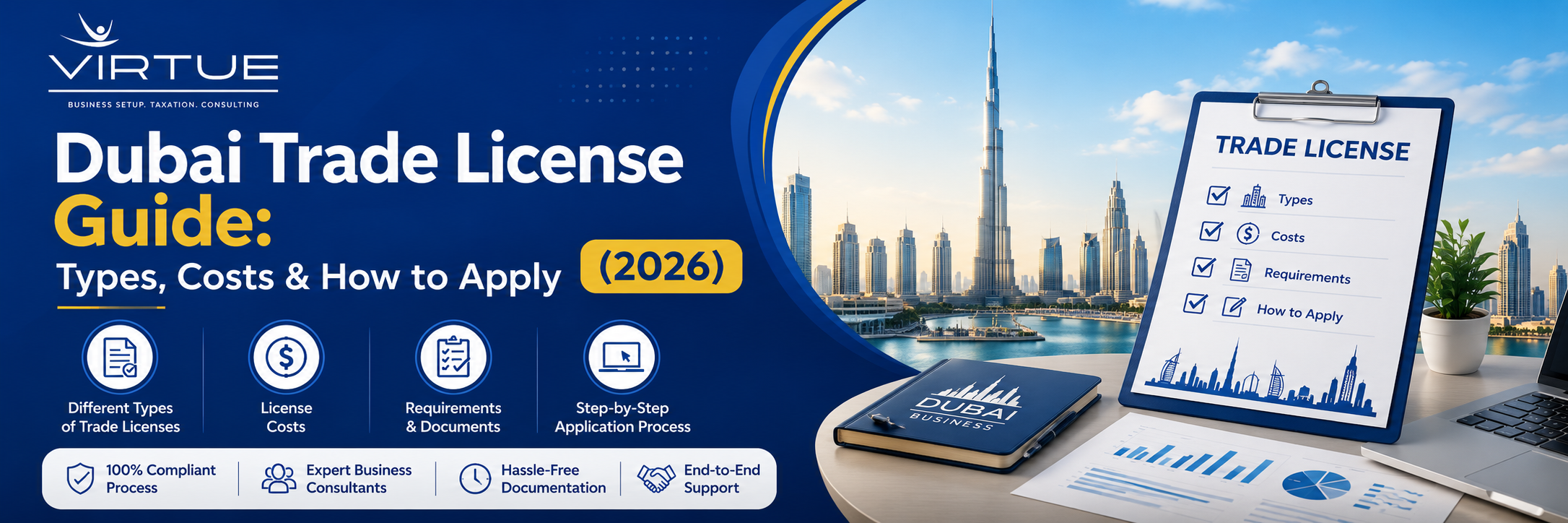
This guide covers everything you need to get your licence right the first time: the different types, current 2026 costs, mainland vs free zone vs offshore, the full step-by-step process, renewal, and the questions we’re asked most often. If you’d rather have it handled end-to-end, our business setup consultants in Dubai can manage the entire company setup Dubai process on your behalf, from choosing the right activity code through to your final license.
What Is a Trade License in Dubai?
A trade licence – sometimes called a commercial licence or business licence – is the official document issued by a government authority that authorises a company to carry out a specific business activity in Dubai. On the mainland, it’s issued by the Dubai Department of Economy and Tourism (DET), formerly the Department of Economic Development (DED). Inside a free zone, it’s issued by that zone’s own authority – DMCC, IFZA, Meydan, RAKEZ, and so on each run their own licensing process.
Your licence isn’t just paperwork. It’s tied to specific approved business activities from an official classified list, and everything downstream – your bank account, your visa applications, your ability to bid on contracts – gets checked against it. Operating outside your licensed activity can result in fines, blocked renewals, or worse.
What Are the Types of Trade Licenses in Dubai?
The DET issues several categories of licence. Most businesses fall into one of these five:
Professional License – for individuals and companies delivering expertise or services rather than goods: consultants, lawyers, accountants, marketing agencies, IT service providers, and similar fields. This licence type has historically permitted 100% foreign ownership even before recent reforms extended that more broadly across the mainland.
Commercial License – for companies buying, selling, importing, exporting, or distributing physical goods, covering both wholesale and retail trading activities.
Industrial License – for businesses engaged in manufacturing, production, or industrial processing – turning raw materials into finished goods. This licence requires a physical facility and, depending on the sector, additional approvals (food production, chemicals, and similarly regulated industries face extra scrutiny).
General Trading License – a broader version of the commercial licence that lets a company trade across many unrelated product categories under a single licence, rather than being restricted to one type of goods. This is popular with import/export and multi-category trading companies.
E-Commerce License – designed specifically for businesses selling goods or services through a website, app, or third-party marketplace. If you plan to sell online – including through platforms like Amazon.ae or noon – this licence (or an activity code that explicitly covers online trading) is a legal requirement, not an optional extra.
Mainland, Free Zone, or Offshore – Which Jurisdiction Do You Need?
Which of the above licence types you get is only half the decision – where you’re licensed matters just as much.
Mainland License – issued by the DET, this lets your company trade anywhere in the UAE and deal directly with the local market, with no restriction on which emirate you operate in. It generally requires a registered physical office (a flexi-desk can be enough for many activities) and typically costs more upfront than an equivalent free zone package, but it opens the door to government contracts and unrestricted domestic trade.
Free Zone License – issued by the specific free zone authority you register with. Business setup in Dubai free zone jurisdictions is often the fastest and cheapest route to market: packages can include bundled visas and flexible office options, and have always allowed 100% foreign ownership regardless of activity. If you’re comparing options for a Dubai freezone business setup, popular zones include DMCC, IFZA, RAKEZ, and Meydan Free Zone, each with its own activity list and pricing. The trade-off with any dubai free zone business setup is that the company generally can’t sell directly into the mainland UAE market without a licensed distributor – although the 2025 reforms mentioned earlier now allow qualifying free zone companies to add a mainland licence alongside their existing one, closing much of that gap for the first time. If you’d like help comparing zones before you set up a company in the Dubai free zone, our team can walk you through which one fits your activity best.
Offshore License – used purely for international structuring. Offshore company formation in Dubai and offshore company setup Dubai (also referred to as offshore company setup in Dubai) are both handled outside the standard mainland/free zone licensing track: an offshore company can’t trade within the UAE or hold physical office space here, but it offers confidentiality and tax efficiency for holding assets or conducting business entirely outside the country. The same applies UAE-wide – offshore company formation in UAE follows a similar structure regardless of which offshore jurisdiction (JAFZA Offshore, RAK ICC, or Ajman Offshore) you register with.
As a rule of thumb: choose mainland if you need to serve UAE clients directly, bid on government tenders, or want a retail presence; choose free zone if you’re focused on international trade, digital services, or want the lowest-cost entry point; choose offshore only if you don’t need a physical UAE presence at all.
Why Get a Trade License in Dubai? (Beyond the Legal Requirement)
Getting licensed isn’t just about compliance – it unlocks real commercial advantages:
- Tax efficiency. The UAE has no personal income tax, and many business structures qualify for corporate tax exemptions or the 0% rate on qualifying free zone income – a major reason the country continues to attract entrepreneurs relocating their business and their residency together.
- Trade access. A general trading licence in particular opens the door to importing, exporting, distributing locally, and re-exporting internationally, all under one licence.
- Strategic location. Dubai sits at the crossroads of Europe, Africa, and Asia, with comparatively few trade restrictions and strong logistics infrastructure.
- Credibility. A properly licensed company is taken more seriously by banks, suppliers, and customers, both locally and internationally.
- Visa sponsorship. Holding a trade licence lets you sponsor your own residency visa, plus those of employees and eligible family members.
- Government support. Licensing in Dubai is generally faster and less bureaucratic than in many comparable jurisdictions, backed by a genuinely business-friendly regulatory environment.
Documents Required to Apply
Exact requirements vary by activity and legal structure, but most applications need:
- A signed trade licence application form (signed by all company managers)
- Memorandum of Association (for LLCs and multi-shareholder structures), drafted with a legal representative
- Trade name approval/reservation certificate
- Passport copies for all shareholders, partners, and managers
- Passport-size photographs
- Proof of a registered office / attested Ejari tenancy contract (mainland)
- Any external regulatory approvals your specific activity requires
Step-by-Step: How to Get a Dubai Trade License
1. Choose your trade name. It must follow UAE naming conventions and not already be in use by another registered entity.
2. Define your legal structure. Common options include Sole Establishment, Limited Liability Company (LLC), Civil Company, Branch of a Foreign Company, and Free Zone Company – each with different ownership and liability implications.
3. Define your business activities. List every activity you plan to carry out; most licences allow up to ten activities under one licence, so it’s worth thinking ahead about anything you might add later rather than amending repeatedly.
4. Submit your application for initial approval. This confirms there’s no objection to you proceeding with your chosen name, activity, and structure.
5. Secure any external approvals. Certain activities (healthcare, education, transport, food, and others) require sign-off from a separate government body before your licence can be issued – research this early, since it’s the most common cause of delay.
6. Gather your supporting documents, including identification for all parties and any required signatures.
7. Choose your business location. Mainland applicants need a tenancy contract attested by Ejari; free zone applicants typically choose from flexi-desk, shared office, or dedicated office packages offered by the zone.
8. Choose your licence pathway. The DET generally offers three routes:
- Normal License – requires a drafted Memorandum of Association and a standard lease agreement.
- Instant License – a simplified route for activities that don’t require external approval, often issued in a matter of minutes, including a virtual office option for the first year. Available to LLCs, Single-Owner LLCs, Sole Establishments, and Civil Companies.
- DED Trader License – aimed at home-based businesses, issued through the government’s digital investment platform, and priced far lower than a standard licence (see the fee table below).
9. Add all licence parties and beneficial owners, including nationality, contact details, job titles, and ownership shares.
10. Submit your full application and pay the licensing fees.
11. Sign legal documents electronically, including the Memorandum of Association, with all partners registered on the relevant platform.
12. Receive your final trade license and supporting documents once payment and signatures are complete.
How Much Does a Dubai Trade License Cost in 2026?
Cost depends heavily on your business activity, legal structure, number of partners, and whether external approvals apply. As a general guide, most standard commercial or professional licences fall somewhere between AED 15,000 and AED 50,000, though very simple structures can cost much less and complex, multi-approval activities can cost more.
Below is a breakdown of individual government fee components published by the DET – you won’t pay every line item, only the ones relevant to your specific application:
| Fee Type | Cost (AED) |
| DED Trader License (home-based business) | 1,070 + 300 (Dubai Chamber membership) |
| Intelaq License | 1,070 |
| License Registration Fee | 600 |
| General Trading Activity Fee | 15,000 |
| Investment Activity Fee | 15,000 |
| Business Center Fee | 25,000 |
| Building Contracting Activity Fee | 10,000 |
| Real Estate Activity Fee | 5,000 – 25,000 |
| Foreign Trade Name Fee | 1,000 – 3,000 |
| Trade Name Advertisement | 350 |
| Service Request Form | 50 |
| Knowledge Dirham Fee | 10 |
| Innovation Dirham Fee | 10 |
| Memorandum of Association / Service Agent Contract (≤ AED 100,000 value) | 300 per signature |
| Memorandum of Association (> AED 100,000 value) | 0.5% of document value, capped at 15,000 |
| Electronic signature (per partner) | 100 |
Free zone packages are typically bundled differently – commercial and professional licences in zones like IFZA, RAKEZ, or Meydan often start from roughly AED 11,900–20,000, inclusive of the licence and a basic flexi-desk allowance, though this varies by zone and package.
Government fees are updated periodically. Always confirm current figures with our team or the relevant authority before budgeting a final number.
How Long Does Approval Take?
Once your documents are complete and any required external approvals are in hand, turnaround is typically three days to four weeks, depending on your activity and how many approvals are involved. Free zone licences tend to move faster – often 48–72 hours once your paperwork is finalised – while mainland licences involving external regulatory sign-off (healthcare, transport, education, and similar) will run on that regulator’s own timeline. Having every document correctly prepared before submission is the single biggest factor in avoiding delays.
How to Renew a Trade License in Dubai
Trade licences are valid for one year and must be renewed to remain in good standing. The general process:
- Secure any required approvals relevant to your renewal (for example, transport companies need sign-off from the Roads and Transport Authority).
- Check compliance – confirm your leases, permits, and business activities are all still current and accurate.
- Clear any outstanding fines before applying, since these will hold up renewal.
- Renew your tenancy contract if needed – you’ll typically need at least a month of validity remaining on your Ejari registration.
- Gather your renewal documents, typically including the renewal form, attested Ejari, authorisation letters, a valid tenancy contract, recent photos of all partners, and payment confirmation.
- Submit and pay your renewal fees to the DET or your free zone authority.
Start this process at least a month before expiry – late renewal typically carries a per-month penalty, and letting a licence lapse for an extended period can mean starting the application from scratch rather than simply renewing it.
What Happens After Your License Is Issued?
Getting the licence is a milestone, not the finish line. Two things typically follow immediately:
Corporate bank account opening Dubai. Corporate bank account opening in Dubai, or company bank account opening in Dubai if you’re comparing providers, requires your trade licence, MOA, shareholder documents, and – increasingly – a clear business plan the bank can use to understand your expected transaction activity. Banks assess this carefully, so getting it right the first time matters more than people expect.
Ongoing corporate services. Once licensed, most companies need some combination of accounting, VAT/corporate tax filing, PRO services, and compliance support to stay in good standing. Whether you’re looking for corporate services UAE-wide or a corporate service provider in Dubai specifically for your licensed entity, working with a single corporate business services Dubai partner for both your setup and your ongoing compliance tends to be far simpler than piecing it together from separate providers later.
Ready to Get Licensed?
Choosing the wrong licence type, activity code, or jurisdiction is one of the costliest mistakes new business owners make in Dubai – often only discovered when a bank account application or visa gets rejected months later. As a business setup company in Dubai founded by banking and tax professionals, we can walk you through exactly which licence fits your actual business plan, with transparent pricing from day one.
Whether you’re comparing a business setup in UAE for the first time or you already know you want to set up a company in Dubai on the mainland or in a free zone, our team handles the entire process end to end.
Get a Free Consultation | Calculate My Setup Cost
Frequently Asked Questions
Do I need a trade license to sell online in the UAE?
Yes. Selling through your own website, an app, or a third-party marketplace (including Amazon.ae) legally requires a trade licence covering online trading activity – an E-Commerce licence, or a standard licence with the relevant activity code added.
What’s the cheapest trade license option in the UAE?
Free zone packages aimed at freelancers and small businesses tend to be the most affordable route, with some basic packages starting from roughly AED 11,000–15,000, though this varies by zone and activity.
Can a foreigner own 100% of a company in Dubai?
Yes. Free zone companies have always allowed full foreign ownership, and since the UAE’s 2021 companies law reforms, most mainland activities now permit 100% foreign ownership too, without requiring a local Emirati partner.
Do I need a physical office to get a trade license?
Mainland licences require a registered office, though a flexi-desk is sufficient for many activities. Many free zones offer flexi-desk or virtual office packages that satisfy the requirement at a lower cost.
Can I add business activities to my license later?
Yes, though this may involve additional fees and, in some cases, new approvals – it’s more efficient to plan your full activity list upfront rather than amending repeatedly.