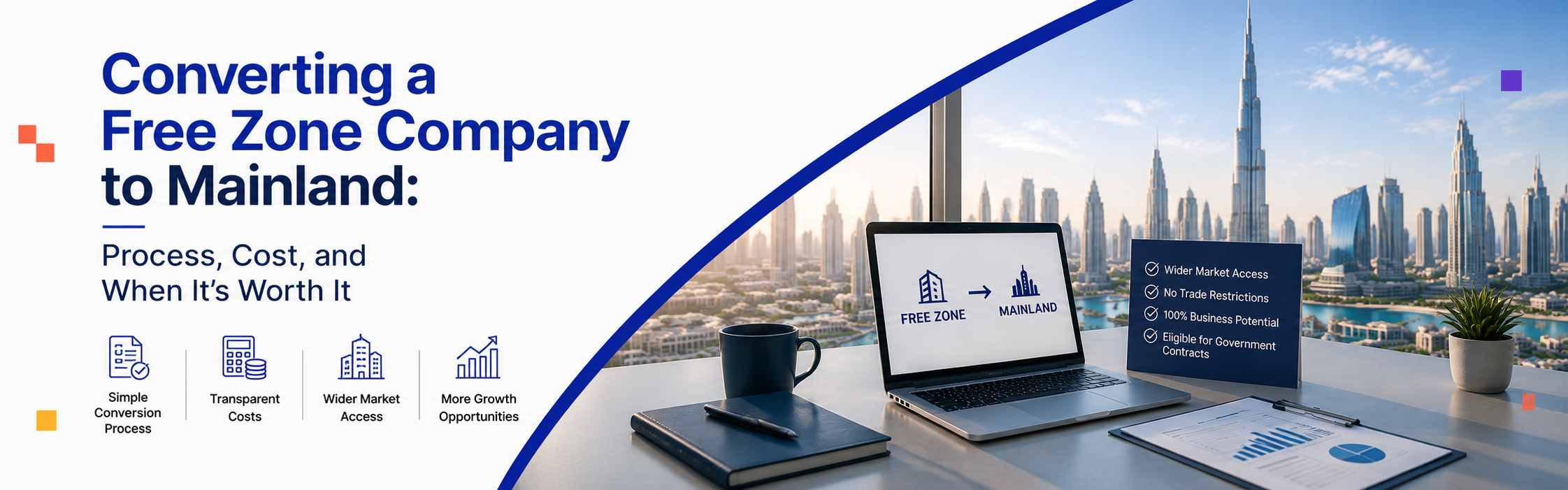
Most entrepreneurs who set up in Dubai start in a Free Zone, and for good reason: 100% foreign ownership, fast registration, and low setup costs make it the natural entry point. But business needs change. A company that once served international clients from a Free Zone office may now want to bid on a local government contract, sign directly with a UAE-based buyer, or open a shop in Deira instead of shipping everything through a distributor.
This is the point at which many owners start asking whether it makes sense to convert their Business Setup in Dubai Free Zone into a full Mainland Business Setup Dubai. It isn’t a decision to take lightly – a conversion touches your license, contracts, visas, and banking relationships. This guide walks through the full picture: how Free Zone and Mainland structures differ, the situations that typically trigger a move, the exact steps involved, realistic costs, common pitfalls, and how working with experienced Business Setup Consultants in Dubai can keep the transition smooth.
Table of Contents
- Understanding Free Zone and Mainland Companies
- Why Businesses Convert from Free Zone to Mainland
- Is Conversion the Right Choice?
- Step-by-Step Conversion Process
- Documents Required
- Cost of Converting a Free Zone Company
- Benefits of Moving to the Mainland
- Challenges and Considerations
- Common Mistakes to Avoid
- Why Work with Business Setup Consultants?
- How Virtue Corporate Services Can Help
- FAQs
- Conclusion
Understanding Free Zone and Mainland Companies
A Free Zone company is registered within one of the UAE’s designated economic zones (such as DMCC, JAFZA, Meydan, or DIP) and is regulated by that zone’s own authority rather than the Department of Economic Development (DED). Free Zones were built to attract foreign investment, so they offer full foreign ownership, tax incentives, and a quick setup process – but in exchange, activity is generally restricted to operating within the zone, internationally, or through a local distributor.
A Mainland company, registered through the DED of the relevant Emirate, can trade anywhere in the UAE without restriction, take on government and semi-government contracts, and open branches across the country. Mainland rules have also opened up considerably in recent years, with 100% foreign ownership now permitted for most business activities – closing much of the ownership gap that used to exist between the two structures.
The real difference today isn’t ownership; it’s market access and operational reach.
| Feature | Free Zone | Mainland |
| Ownership | 100% foreign ownership | 100% foreign ownership (most activities) |
| Market Access | Restricted to the zone, other Free Zones, or international trade | Full access to the UAE local market |
| Office Requirements | Flexi-desk or shared office often sufficient | Physical office typically required, sized to activity |
| Visa Eligibility | Limited by facility size/package | Tied to office size, more scalable |
| Business Activities | Limited to the zone’s permitted activity list | Wide range of activities, including many combined under one license |
Choosing the right jurisdiction from the start matters, because your Dubai Free Zone Business Setup or Company Formation in Dubai Mainland shapes how easily you can scale, hire, and contract in the years ahead.
Why Businesses Convert from Free Zone to Mainland
Owners typically consider a move for one or more of these reasons:
- Expanding into the UAE local market – selling directly to UAE-based customers rather than through a distributor.
- Government contracts – many tenders and semi-government projects require a Mainland license.
- More business activities – Mainland licenses often allow broader, combined activity lists.
- Hiring flexibility – visa allocations scale more easily with a Mainland office.
- Business growth – outgrowing the space, activity scope, or client base a Free Zone allows.
- Better long-term scalability – branches, warehouses, and retail presence across Emirates.
- Client requirements – some UAE clients or banks prefer contracting with Mainland entities.
- Operational flexibility – fewer restrictions on where and how you conduct business.
None of these reasons make conversion mandatory – they simply signal that it’s worth evaluating.
Is Converting to a Mainland Company the Right Choice?
Before starting the process, it helps to map your business goal against the structure it actually needs.
| Business Goal | Recommended Structure |
| International trading | Free Zone |
| UAE local market | Mainland |
| Government projects | Mainland |
| Startup with limited budget | Free Zone |
| Expansion across UAE | Mainland |
Expert Tip: Base the decision on where your business is heading over the next three to five years, not on this quarter’s setup cost. A Mainland conversion carries higher upfront and ongoing expenses, but for a company aiming at the local UAE market or public-sector contracts, the return usually outweighs that cost well within the first year or two.
Step-by-Step Process to Convert a Free Zone Company to Mainland
Converting isn’t a single filing – it’s a sequence of approvals that has to be handled in order.
Step 1 – Assess Business Eligibility
Confirm your current activity, ownership structure, and any existing approvals qualify for a Mainland license, and identify whether the business needs to be newly incorporated or can be migrated as a continuing entity.
Step 2 – Select the Appropriate Mainland License
Choose between commercial, professional, or industrial license categories based on your actual operations, and confirm which activities can be combined under one license.
Step 3 – Reserve the Trade Name
Register your trade name with the relevant DED, keeping the same brand name where possible, or securing an approved alternative.
Step 4 – Obtain Initial Approvals
Secure initial approval from the DED and any activity-specific regulator (for example, health, education, or food authorities) before proceeding further.
Step 5 – Prepare Legal Documentation
Draft or amend the Memorandum of Association (MOA), shareholder resolutions, and any local service agent agreements required for your activity and ownership structure.
Step 6 – Lease Office Space (if applicable)
Secure a physical office that meets Ejari/tenancy requirements for your chosen activity and expected visa quota.
Step 7 – Apply for the Mainland License
Submit the completed application, documentation, and lease details to the DED to obtain the Mainland trade license.
Step 8 – Update Bank Accounts, Contracts & Registrations
Update your corporate bank account, VAT registration, employee visas, contracts, and any government portals to reflect the new license and legal entity details.
A simple way to track this: treat it as a checklist you tick off in order – eligibility, license type, name, approvals, documents, office, license issuance, then post-conversion updates. Skipping ahead (for example, signing a lease before confirming activity eligibility) is one of the most common causes of delay.
Documents Required for Company Conversion
Have these ready before you start, since gathering them mid-process is what usually slows things down:
- Existing Free Zone trade license
- MOA/AOA (current and draft updated versions)
- Shareholder and ownership documents
- Passport copies of all shareholders and managers
- Emirates ID (where applicable)
- Copies of existing employee/investor visas
- NOC from the Free Zone authority (where required)
- Office lease/tenancy contract (Ejari)
- Business activity approvals from relevant regulators
Cost of Converting a Free Zone Company to Mainland
Costs vary by Emirate, business activity, and licensing authority, so fixed pricing isn’t realistic – but the components are consistent across most conversions.
| Cost Component | Description |
| Government fees | DED registration, name reservation, and initial approval charges |
| License fees | Cost of the new Mainland trade license, based on activity type |
| Office lease | Annual rent for a qualifying physical office space |
| Immigration charges | Establishment card and visa quota registration |
| Visa costs | New or transferred employee and investor visa fees |
| Documentation | Notarization, translation, and attestation of legal documents |
| Professional service fees | Charges for consultants managing the end-to-end process |
Businesses in a smaller activity category with modest office needs will sit at the lower end of this range; those needing larger office space, multiple activities, or additional regulatory approvals will pay more. A consultant can usually give you an accurate estimate once your activity and headcount are known.
Benefits of Moving to a Mainland Company
- Direct access to the UAE market – trade with local customers without a distributor.
- Ability to work with government entities – eligibility for public-sector tenders.
- Greater operational flexibility – open branches, retail outlets, or warehouses across Emirates.
- Easier business expansion – scale offices and headcount without Free Zone facility limits.
- More licensing options – combine multiple activities under one license in many cases.
- Better long-term scalability – build a structure that grows with the business rather than around zone restrictions.
Challenges and Important Considerations
Conversion isn’t without friction. Plan for:
- Compliance requirements – Mainland entities face different, sometimes stricter, regulatory oversight.
- Office requirements – a genuine physical office is usually mandatory, unlike some Free Zone flexi-desk options.
- Regulatory approvals – certain activities need sign-off from sector-specific authorities, which can add time.
- Additional operating costs – rent, larger visa quotas, and updated insurance can raise your cost base.
- Tax considerations – confirm how the move affects your VAT and Corporate Tax position.
- Business continuity – contracts, bank accounts, and supplier relationships need to transition without disrupting operations.
Common Mistakes to Avoid During Company Conversion
- Choosing a business activity that doesn’t match actual (or future) operations
- Starting the process without a clear plan or timeline
- Ignoring specific licensing or regulatory requirements for the activity
- Underestimating the full cost, including hidden fees
- Delaying updates to contracts, visas, and bank records after the license is issued
- Selecting consultants based on price alone rather than track record
Why Work with Business Setup Consultants in Dubai?
A Free Zone-to-Mainland conversion touches legal structuring, government liaison, banking, and compliance at the same time – which is exactly where experienced Business Setup Consultants in Dubai add the most value. They typically handle:
- Legal guidance on structure and ownership
- Preparation and review of documentation
- Coordination with DED and sector regulators for approvals
- Business restructuring advice suited to your growth plans
- Ongoing compliance after the license is issued
- Time savings by managing submissions and follow-ups directly
- Risk reduction by avoiding the common mistakes listed above
How Virtue Corporate Services Simplifies Company Migration
Virtue Corporate Services works with Free Zone business owners through every stage of a Mainland transition, including:
- Free Zone to Mainland transition planning
- Business restructuring advice tailored to your growth goals
- Mainland licensing across all major activities
- Coordination of government approvals
- Full documentation support and preparation
- Office setup assistance to meet lease and activity requirements
- Corporate banking coordination
- Accounting & bookkeeping
- VAT & Corporate Tax compliance
- PRO services for visas and government transactions
- End-to-end migration support from a dedicated consultant
Rather than handling each step with a different provider, business owners get one team managing the legal, financial, and administrative sides of the move together.
Conclusion
Not every Free Zone business needs to move to the Mainland. The right call depends on your target market, growth plans, compliance needs, and whether local trading or government contracts are part of your future. For companies whose ambitions have outgrown their zone’s restrictions, though, a well-planned conversion opens real doors – direct access to UAE customers, broader licensing options, and room to scale.
Getting there without costly missteps takes the right guidance. If you’re weighing a move from a Business Setup in Dubai Free Zone to a Mainland Company Formation Dubai, Virtue Corporate Services can walk you through business restructuring, company migration, and ongoing Corporate Services UAE support – so the transition strengthens your business rather than slowing it down. Get in touch with Virtue Corporate Services to start planning your move.
Frequently Asked Questions
Can a Free Zone company convert to a Mainland company?
Yes. The Free Zone entity can be closed and a new Mainland license issued, or in some cases restructured directly, depending on the activity and Emirate.
How long does the conversion process take?
Timelines vary by activity and approvals needed, but most conversions take several weeks once documentation is complete.
What documents are required?
Your existing trade license, MOA/AOA, shareholder and passport copies, visa copies, NOC (if required), and office lease documents, among others listed above.
How much does the conversion cost?
Costs depend on the Emirate, activity, office size, and visa quota – a consultant can provide an accurate quote based on your specific setup.
Will I need a new trade license?
Yes, a Mainland trade license from the relevant DED replaces the Free Zone license.
Can I keep the same company name?
In most cases yes, provided the name is available and meets DED naming rules; otherwise an approved alternative is used.
Do I need a physical office?
Generally yes – Mainland licenses typically require a qualifying office space rather than a flexi-desk.
What happens to existing visas?
Employee and investor visas are updated or reissued under the new Mainland establishment card.
Can Business Setup Consultants help with the process?
Yes – from eligibility assessment through licensing, documentation, and post-conversion updates, consultants manage the process end-to-end.
Why choose Virtue Corporate Services?
Virtue Corporate Services combines legal, licensing, banking, and tax expertise under one dedicated team, reducing the coordination burden on business owners during migration.