
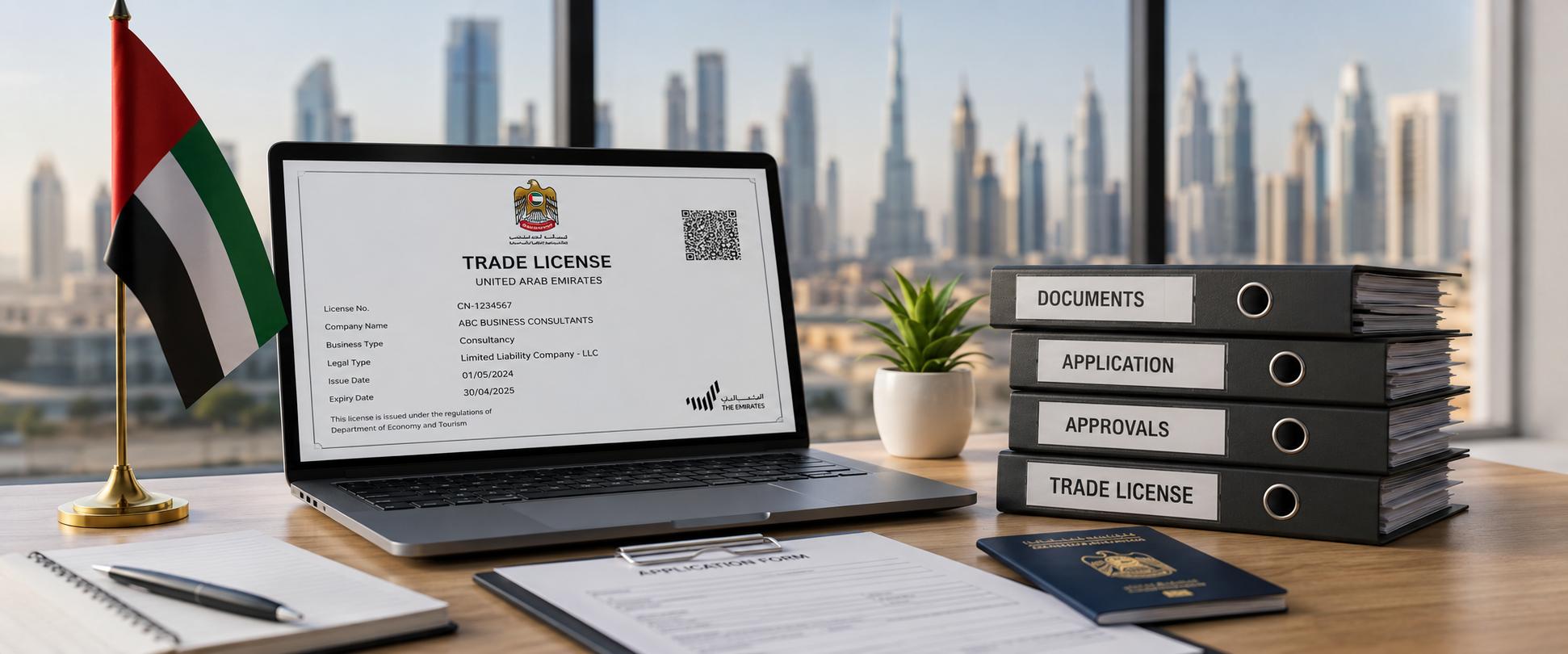
If you’re planning to start a business in the UAE, one question comes before almost everything else: what is a trade license, and which one do you actually need?
A trade license is the legal authorization that allows a company to operate in the UAE – without it, a business simply cannot legally conduct commercial activity, open a corporate bank account, or sponsor employee visas. But “getting a trade license” isn’t a single, uniform process. The right license depends heavily on your business activity, and the jurisdiction you choose – mainland or free zone – shapes everything from ownership rules to cost to how the application actually works.
This guide walks through the different types of UAE trade licenses, why they matter, the mainland-vs-free-zone decision, the full application process, required documents, realistic cost and timeline expectations, and how to choose the right path for your business heading into 2026.
What Is a Trade License in the UAE?
A UAE trade license is an official document issued by a licensing authority that permits a business to carry out a specific commercial, professional, industrial, or other regulated activity within the country. Without it, a business cannot legally operate, invoice clients, sign contracts, or access essential services like corporate banking.
Trade licenses are issued either by a mainland licensing authority (such as an emirate’s Department of Economic Development) or by the free zone authority governing a specific free zone. Which authority applies depends entirely on where you choose to set up.
It’s also worth separating two related but distinct concepts: a trade license is permission to conduct a specific business activity, while company registration is the process of legally creating the entity itself. The two happen alongside each other during setup, but they aren’t the same thing.
One point the UAE government is clear on: selecting your business activity is one of the very first steps in the process, because it determines the appropriate legal form and license type available to you. Get this step wrong, and the rest of the application can run into complications.
Why Do You Need a Trade License in the UAE?
Legal Authorization to Operate
A trade license grants the legal right to conduct the specific activities listed on it. Operating outside those permitted activities – or without a license at all – creates compliance risk.
Open a Corporate Bank Account
Banks require a valid trade license as core documentation before opening a corporate account, since it confirms the business is legally registered and its activities are clearly defined.
Hire Employees and Apply for Visas
Employee visa sponsorship is tied to your company’s establishment registration, which in turn depends on holding a valid trade license.
Build Business Credibility
A valid license signals to clients, partners, and government bodies that your business is formally registered and operating within the regulatory framework – which matters for winning contracts and building trust.
Sign Commercial Contracts and Lease Business Premises
Most landlords, suppliers, and corporate clients will ask to see your trade license before finalizing agreements, since it confirms your legal standing to enter into commercial arrangements.
Maintain Regulatory Compliance
Licenses require periodic renewal, and business activities are restricted to what’s listed on the license itself. Additional government approvals may apply depending on your sector.
Businesses working with a corporate service provider in Dubai often rely on that support specifically to keep licensing, renewals, and related corporate services compliant on an ongoing basis, rather than managing it all independently. This is generally where corporate services UAE providers add the most value – not just at the point of setup, but through the entire lifecycle of the license. Whether it’s described broadly as corporate services or more specifically as corporate business services Dubai, the goal is the same: keeping the business compliant without it becoming a full-time distraction from actually running the company.
Types of Trade Licenses in the UAE
At the federal level, the UAE identifies several broad license categories – industrial, commercial, professional, tourism, agricultural, and craftsmanship – though individual emirates and free zones can maintain additional or more specific categories. It’s worth noting upfront: not every authority offers identical license categories, and the exact list can vary by jurisdiction.
1. Commercial License
Covers activities such as trading, import and export, retail, wholesale, general trading, and distribution. This is typically the starting point for businesses buying and selling goods.
2. Professional License
Covers service- and skill-based activities, including consultancy, IT services, marketing, accounting, design, and other professional services.
3. Industrial License
Covers manufacturing, production, processing, and other industrial activities – typically requiring additional approvals tied to facility and safety requirements.
4. Tourism License
Covers eligible tourism-related business activities, generally requiring approval from the relevant tourism authority.
5. Agricultural License
Covers relevant agricultural business activities.
6. Craftsmanship License
Covers skilled trades and craftsmanship-based activities.
Other Licence Categories and Special Licence Options
Depending on the jurisdiction and specific activity, some authorities offer additional or specialized license types beyond the categories above. Since requirements differ by emirate and free zone, it’s worth confirming the exact categories available for your specific activity before assuming a standard list applies everywhere.
Mainland vs Free Zone Trade License in the UAE
This is one of the most consequential decisions in the entire setup process, and it deserves careful thought rather than a default choice.
Mainland Trade License
A mainland license is issued by the relevant emirate’s economic development authority and grants access to the broader UAE mainland market, including the ability to trade directly with government entities and across the local market without the restrictions that can apply to free-zone entities. Mainland setup typically involves specific office requirements, and depending on the activity and ownership structure, may involve additional government or regulated-activity approvals.
Free Zone Trade License
A free zone license is issued by the specific free zone authority governing that zone, and comes with rules and packages specific to that jurisdiction. Free zones typically offer flexible office options – including flexi-desk arrangements in many zones – along with their own visa allocations, ownership structures, and cost packages. Requirements and included benefits vary considerably from one free zone to another.
Which One Should You Choose?
The right choice depends on several factors working together:
- Your core business activity
- Your target market (UAE mainland vs. international/free-zone trade)
- Number of shareholders
- Visa requirements
- Office space needs
- Budget
- Banking requirements
- Future expansion plans
If you’re specifically considering business setup in a Dubai free zone, it’s worth comparing jurisdictions carefully rather than choosing based on price alone – packages differ meaningfully in what’s actually included. This path shows up under a lot of different searches – Dubai free zone business setup, setup company in Dubai free zone, Dubai freezone business setup, free zone business setup Dubai, and free zone company setup in Dubai all describe the same core process. Whatever the phrasing, the underlying decision is the same one covered here. We cover freezone business setup and jurisdiction comparisons in more depth in our dedicated free-zone resource.
Trade License for Free Zone Business Setup in Dubai
How Free Zone Licensing Works
The general sequence looks like this:
- Choose your business activity
- Select a free zone
- Select the license type
- Choose your legal structure
- Submit required documents
- Obtain approval
- Pay applicable fees
- Receive your license
Popular Free Zones for Business Setup in Dubai
Dubai hosts several well-established free zones, each with its own focus areas, cost structures, and benefits – including Meydan, IFZA, DMCC, and Dubai South. Rather than attempting a full comparison here, we’ve put together a dedicated resource comparing these free zones in detail.
Meydan Free Zone Business Setup
Meydan Free Zone is a popular option for entrepreneurs looking for flexible packages and straightforward setup processes, particularly for service-based and trading activities. Business setup in Meydan free zone is one of the more frequently asked-about routes among first-time founders specifically because of its streamlined packages. For a closer look at whether it fits your specific business, our dedicated Meydan free zone business setup page covers the details.
How to Apply for a Trade License in the UAE
Step 1: Choose Your Business Activity
This comes first because it determines your eligible legal structures, license type, and in some cases, jurisdiction options.
Step 2: Choose the Jurisdiction
Decide between mainland and free zone based on the factors covered above.
Step 3: Select the Legal Structure
Common structures include LLC, Sole Establishment, Free Zone Establishment, Free Zone Company, and Branch – though the exact options available depend on your chosen jurisdiction.
Step 4: Reserve a Trade Name
Your trade name needs to comply with relevant naming rules, include any required legal-form suffix, and must not already be registered to another entity. Name reservation is typically one of the earlier formal steps in the process.
Step 5: Obtain Initial Approval
Initial approval confirms the government has no objection to you proceeding with the business setup – but it’s important to understand this on its own does not authorize you to begin operating.
Step 6: Prepare the Required Documents
Documentation requirements vary by activity, jurisdiction, and whether shareholders are individuals or corporate entities (covered in detail below).
Step 7: Secure Office or Workspace
Office requirements vary significantly depending on your activity and jurisdiction – some free zones offer flexi-desk options, while certain mainland activities require a physical office meeting specific criteria.
Step 8: Obtain Additional Approvals
Certain regulated activities require sign-off from other government authorities beyond the primary licensing body.
Step 9: Pay the Fees
Fees typically include the license fee itself along with any activity-specific or establishment-related charges.
Step 10: Receive the Trade License
Once all approvals and payments are complete, the license is issued and the business is authorized to operate.
Documents Required for a UAE Trade License
Exact requirements vary by jurisdiction and legal structure, but common documentation includes:
For Individual Shareholders
- Passport copy
- Passport-size photograph
- Visa or entry documentation where applicable
- Business activity details
- Completed application form
- Trade name information
For Corporate Shareholders
- Certificate of incorporation
- Existing company license
- Memorandum and Articles of Association (MOA/AOA)
- Board resolution
- Authorized signatory documents
- Parent company documents
Additional Documents (Depending on Business Type)
- Tenancy or lease agreement
- Initial approval documentation
- MOA for the new entity
- External authority approvals
- Other activity-specific documents
Since exact requirements differ by jurisdiction and structure, mainland guidance generally lists items such as attested lease documentation, MOA, initial approval, and relevant external approvals among what’s needed to finalize a license – it’s worth confirming the specific list with your chosen authority or setup consultant before applying.
How Much Does a Trade License Cost in the UAE?
There’s no single, universal price for a UAE trade license – and any source claiming otherwise is oversimplifying. Cost depends on a combination of factors:
- Jurisdiction (mainland vs. specific free zone)
- License type
- Business activity
- Number of activities included
- Office requirement
- Number of visas needed
- Legal structure
- Establishment card fees
- External authority approvals
- Additional government fees
It also helps to separate initial setup cost from recurring annual cost – license renewal, office renewal, and visa-related costs continue year over year and should be factored into your budgeting from the start.
Free-zone packages in particular can vary considerably, and headline pricing doesn’t always reflect what’s actually included. It’s worth comparing based on the full package – activities allowed, visa allocation, and office type – rather than the advertised price alone.
How Long Does It Take to Get a UAE Trade License?
Timelines vary meaningfully depending on the authority, activity, and whether additional approvals are required. Mainland setups involving regulated activities or multiple external approvals typically take longer than straightforward free-zone setups. Document preparation, office arrangements, and – as a separate process entirely – corporate banking, all add to the overall timeline.
It’s worth noting that the UAE’s Basher platform allows certain eligible investors to complete company formation through an integrated online service, with the process reportedly completable in as little as 15 minutes in eligible cases. That said, this shouldn’t be treated as a universal timeline – most setups, particularly those involving specific activities, additional approvals, or physical office requirements, take longer.
How to Renew a Trade License in the UAE
Renewal generally involves:
- Confirming the license validity period and renewal window
- Submitting required renewal documents
- Confirming tenancy or office documentation is current
- Paying renewal fees
- Updating any changed business information
Requirements vary by licensing authority, so it’s worth checking the specific renewal process for your mainland authority or free zone well ahead of the expiry date to avoid late-renewal complications.
What Happens If a UAE Trade License Expires?
Letting a license lapse creates real operational risk. Depending on the authority and how long the license has been expired, businesses can face compliance issues, potential fines, difficulty accessing banking and government services, and complications tied to visas or establishment registration. Exact penalties vary by emirate and authority, so rather than relying on a general figure, it’s worth confirming current fine schedules directly with your licensing authority or setup consultant if your license is at risk of lapsing.
How to Choose the Right Trade License for Your Business
A practical decision framework comes down to seven factors:
- Business activity
- Mainland or free zone
- Target customers
- Ownership structure
- Visa requirements
- Office requirements
- Future expansion plans
In practice, this often maps out fairly intuitively:
- A consultant typically needs a Professional/Service license
- A trading company typically needs a Commercial license
- A manufacturer typically needs an Industrial license
- An online business may need an e-commerce license or a relevant commercial/service license, depending on the specific activity and jurisdiction
Can Foreigners Get a Trade License in the UAE?
Yes, foreign entrepreneurs can obtain UAE trade licenses, and free zones in particular are widely used specifically because they offer full foreign ownership across most activities. Mainland ownership rules have also become considerably more flexible for many activities in recent years.
That said, it’s worth being precise rather than making a blanket claim: ownership rules still depend on the specific business structure, activity, and jurisdiction, and certain regulated activities carry their own ownership or approval requirements. It’s worth confirming the current rules for your specific activity rather than assuming a universal “100% foreign ownership” policy applies across the board.
Trade License vs Business License vs Company Registration
These terms get used interchangeably, but they mean different things:
- Trade License – Permission to conduct specified business activities.
- Company Registration / Incorporation – The creation and legal registration of the business entity itself.
- Business Setup – The broader overall process, encompassing activity selection, jurisdiction choice, legal structure, licensing, office arrangements, visas, banking, and ongoing compliance.
Understanding this distinction matters whether you’re pursuing business setup in UAE broadly, or specifically evaluating company setup Dubai and comparing structures across jurisdictions. In practice, most people search this stage using fairly interchangeable phrasing – setup company in Dubai, company setup in UAE, business setup company in Dubai – all pointing to the same overall process described above.
How a Business Setup Consultant Can Help With Trade Licensing
Navigating activity selection, jurisdiction comparison, documentation, and approvals can be genuinely complex – which is exactly where experienced Business Setup Consultants in Dubai add value.
Activity and License Selection
Helping you choose the correct activity and license type based on what you actually plan to do, avoiding costly mismatches later.
Mainland vs Free Zone Comparison
Comparing jurisdictions against your specific business needs rather than a generic checklist.
Documentation and Application Support
Managing the paperwork and submission process to reduce delays and rejected applications.
Government Approvals
Coordinating additional approvals required for regulated activities.
Visa and Establishment Support
Handling establishment card registration and visa applications alongside the core licensing process.
Corporate Banking Assistance
Supporting the corporate bank account opening process, which can be one of the more time-consuming steps post-licensing.
Post-Setup Corporate Services
Ongoing support covering accounting, VAT, corporate tax, and PRO services once the business is operational.
This is exactly where Virtue Corporate Services operates – as a full-service business setup consultancy covering licensing, visas, banking, accounting, VAT, corporate tax, and PRO services for businesses working with corporate service providers in Dubai and across the UAE.
Why Choose Virtue Corporate Services for UAE Business Setup?
Rather than relying on broad claims, here’s what sets Virtue apart in practice:
- 3,000+ successful company setups
- Clients from 130+ countries
- End-to-end setup support, from activity selection through licensing
- Expertise across both mainland and free-zone jurisdictions
- Corporate banking support
- Tax and accounting support
- Ongoing post-setup corporate services
If you’re comparing business setup companies in Dubai, these are the kinds of concrete differentiators worth asking any consultant to demonstrate – rather than taking generic “best company” claims at face value.
Frequently Asked Questions
What is a trade license in the UAE?
It’s an official authorization issued by a licensing authority that permits a business to legally conduct a specific activity in the UAE.
What are the different types of trade licenses in the UAE?
The main categories are commercial, professional, industrial, tourism, agricultural, and craftsmanship licenses, with some jurisdictions offering additional specialized categories.
How much does a UAE trade license cost?
There’s no fixed cost – it depends on jurisdiction, license type, business activity, office requirements, visa allocation, and legal structure. It’s best to get a tailored quote based on your specific setup.
What documents are required for a trade license in the UAE?
Common requirements include passport copies, business activity details, application forms, and – for corporate shareholders – incorporation documents and board resolutions, alongside activity-specific approvals where applicable.
How long does it take to get a UAE trade license?
Timelines vary by jurisdiction, activity, and required approvals. Some streamlined processes can move quickly, while setups involving regulated activities or multiple approvals typically take longer.
Can foreigners get a trade license in the UAE?
Yes. Free zones generally allow full foreign ownership across most activities, and mainland ownership rules have become more flexible for many activities – though specific rules still depend on activity and structure.
What is the difference between mainland and free-zone trade licenses?
Mainland licenses are issued by an emirate’s economic authority and allow direct access to the UAE market; free-zone licenses are issued by the specific free zone authority and come with zone-specific rules, packages, and benefits.
Can I get a trade license without an office?
In many free zones, flexi-desk or similar flexible office arrangements are available depending on the activity and package, though requirements vary by zone and by mainland authority.
How do I renew a UAE trade license?
Renewal generally requires submitting updated documentation, confirming valid tenancy where applicable, and paying renewal fees before the license expires – exact requirements vary by authority.
Can I have multiple business activities under one trade license?
In many cases yes, depending on the jurisdiction and whether the activities are compatible under that license type – it’s worth confirming this with the relevant authority for your specific combination of activities.